The public debt and the Bible
In the category Math and numbers, in addition to topics related to mathematics, I decided to write articles that show us numbers related to the reality we live in. This is the first article of this kind.
Several years ago, if I remember correctly at the end of the 1990s, I had the opportunity to attend a show by Giorgio Gaber, a famous italian artist. Gaber was a genius; his songs and monologues stimulated deep reflections on our culture, our society, and our way of life. At that time, I was reading books about how money works, to understand why debt had become an inevitable reality, both at the state and personal levels. In one of his monologues, Gaber talked about Italy’s public debt, which at the time “was just” 2 million billion lire. Written in figures, it has quite an impact. 2,000,000,000,000,000 lire, the equivalent of around 1,000,000,000,000 euros.
Giorgio ended his monologue with this sentence, which I remember very well:
“But to whom do we owe this debt? If it’s someone who doesn’t matter, who cares, we’ll just ignore them and not pay them back. But if it’s someone important, let’s get ready to pay in kind!”
More than 25 years have passed, our currency has changed, and now we have euros instead of lire. As was to be expected, Italy’s public debt has skyrocketed, and we are approaching the threshold of €3 trillion, which is nominally about three times what it was back then.
I tried asking an artificial intelligence tool (Microsoft Copilot) about the distribution of public debt by continent. This is the debt table for 2023 (source: International Monetary Fund, Global Debt Database).
- Europe ~ $25,500,000,000,000
- Asia ~ $22,800,000,000,000
- Americas ~ $24,100,000,000,000
- Africa ~ $1,900,000,000,000
- Oceania ~ $0,900,000,000,000
- Total ~ $75,500,000,000,000
Who are the holders of public debt?
The IMF and OECD statistics (again according to Microsoft Copilot’s response) regarding debt holders are as follows.
- Central banks: 20–30%
- Banks and financial institutions: 25–35%
- Institutional investors (pension funds, insurance companies, funds): 20–30%
- Foreign investors: 10–20%
- Households (individual citizens): 5–10% in advanced countries, 1–3% in emerging countries
These figures paint a picture of a world in which every country on the planet is in debt. Since all countries are in debt, the debt holders are almost entirely central banks, banks and financial institutions, and institutional investors. The table clearly shows that a very small percentage of public debt is held by citizens.
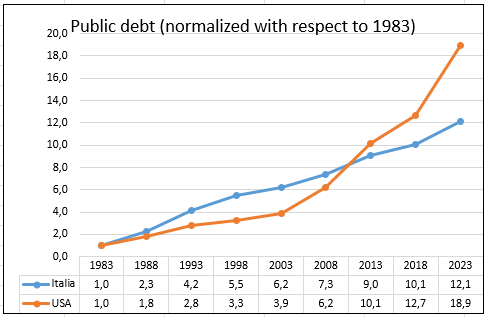
The following graph shows the evolution of public debt in the United States and Italy from 1983 to 2023 (source: CSV file “Global Debt Database” downloaded from the International Monetary Fund website https://data.imf.org/en/datasets/IMF.FAD:GDD). The graph shows the debt level relative to the 1983 level, which is set to 1. In 2023, the most recent year for which data is available, the U.S. had a debt level 18.9 times that of 1983, while Italy’s debt increased by a factor of 12.1 over the same period.
It is not my intention to express opinions or judgments on economic and financial matters that lie well beyond my expertise in the field. It is also clear that the growth of debt is inexorable and, if nothing changes, it will become increasingly difficult to repay it, and cuts to public spending will become ever more severe.
Before concluding, I think it is worth noting that the Bible contains (surprisingly, in my view) a passage that addresses the issue of debt sustainability. I quote below from Chapter 25 of Leviticus1 some excerpts from God’s speech to Moses on Mount Sinai:
“You shall count seven weeks of years—that is, seven times seven years.
… You shall consecrate the fiftieth year and proclaim liberty throughout the land to all its inhabitants. It shall be a jubilee for you; each of you shall return to his property and to his family.
… Land shall not be sold permanently, for the land is mine, and you are but sojourners and strangers with me. Therefore, throughout the land you shall grant the right of redemption regarding the land. If your brother becomes poor and sells part of his property, the one who has the right of redemption—that is, the nearest relative—shall come and redeem what his relative has sold.
… But if he cannot find the money to pay him back, what he has sold shall remain in the buyer’s possession until the Jubilee; at the Jubilee the buyer shall leave and the other shall return to possession of his property.”
The Jubilee was thus the year of land restitution, allowing everyone to start anew. It was a mechanism designed to prevent the accumulation of debt and the concentration of wealth from becoming irreversible. The Jubilee thus broke the eternal and inexorable cycle of debt and the resulting burden on the future caused by debt that grows faster than the ability to generate value.
You can send your comment to info@esperienzedivalore.it, I will be happy to respond.
Translated with DeepL.com (free version)
- “La sacra Bibbia”, Edizione ufficiale della CEI, a cura della Unione Editori Cattolici Italiani, 1974 ↩︎