Systems theory, psychotherapy and Buddhism
Lately, I have often found myself reflecting on the similarities between fields of knowledge that we tend to consider distant from one another. This article aims to explore the similarities between the concept of impulse response in systems theory, the ABC system in cognitive-behavioral psychotherapy, and the principle of cause and effect in Soka Gakkai Buddhism.
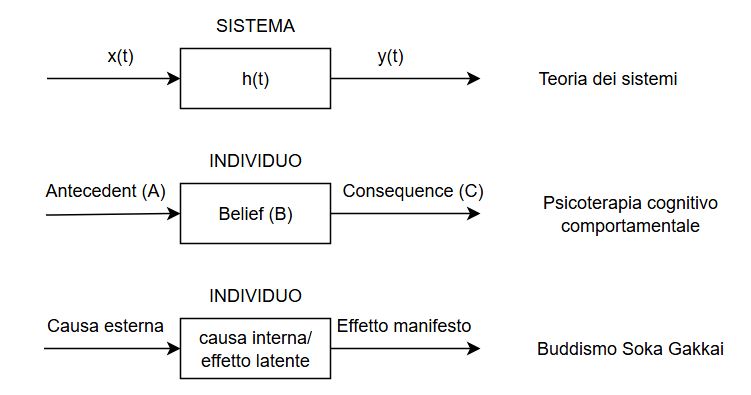
The figure immediately shows the essence of the analogy. The concept of impulse response is a key principle of systems theory, with important applications in electrical engineering, electronics, robotics, and signal theory and processing. For those unfamiliar with this type of study, we can summarize by saying that the impulse response uniquely defines the behavior of a system. Given an input signal x(t) to a system, the output signal y(t) depends on the impulse response of the system, conventionally denoted by h(t). To give a concrete example, let’s think of a loudspeaker whose task is to provide amplified audio output. The impulse response of the amplifier is designed so that the amplified signal has no distortion, and the effects of interference and noise are minimized.
The ABC system is a theory of cognitive-behavioral psychotherapy. In response to an external stimulus such as an event or situation (A: Antecedent), a human being reacts emotionally and acts (C: Consequence) based on their belief system (B: Belief). Two people with different belief systems react differently to the same event, just as two different systems respond differently to the same input signal. For example, consider two students who receive the same disciplinary measure from a teacher. Their reaction depends on their belief system and can vary across a wide spectrum of possibilities: total indifference, frustration and repressed anger, polite but firm and reasoned self-defense, open confrontation with the teacher, silence, and in extreme cases even violent reactions, as we sometimes learn from the news. The purpose of applying the ABC system in psychotherapy is to raise awareness and eventually transform one’s belief system in situations where there is suffering or dysfunction. The psychotherapist guides this path of growth and transformation, with the aim of consolidating appropriate and functional behaviors and reactions.
The ABC system of cognitive-behavioral psychotherapy is similar to the cause-and-effect dynamic in Soka Gakkai Buddhism. Among the ten factors that describe the components of human life, there are four that theorize a behavioral dynamic analogous to the ABC principle. Following an external cause (the equivalent of Antecedent), a manifest effect or retribution (the equivalent of Consequence) is obtained, which depends on the internal condition of the person, represented by the internal cause and the latent effect (Belief). The chain of external cause -> internal cause/latent effect -> manifest effect is the basis of the concept of karma, to which I will devote one of my next articles. Working on oneself to transform karma, through psychotherapy or any other means, allows one to change internal causes and corresponding latent effects in order to grow and improve.
I conclude with two considerations:
- The impulse response describes the behavior of a system, just as the ABC system describes the dynamics of an individual’s behavior.
- The analogy between cognitive-behavioral psychotherapy and Buddhism raises the question of how some theories can lead to substantially similar conclusions, despite having been developed about two millennia apart and in profoundly different technological and intellectual contexts.
Finding common ground where we are used to seeing differences is one of the reasons that drives me to write. You can find other articles inspired by this intention in the category Science and spirituality.
You can send your comment to info@esperienzedivalore.it, I will be happy to respond.